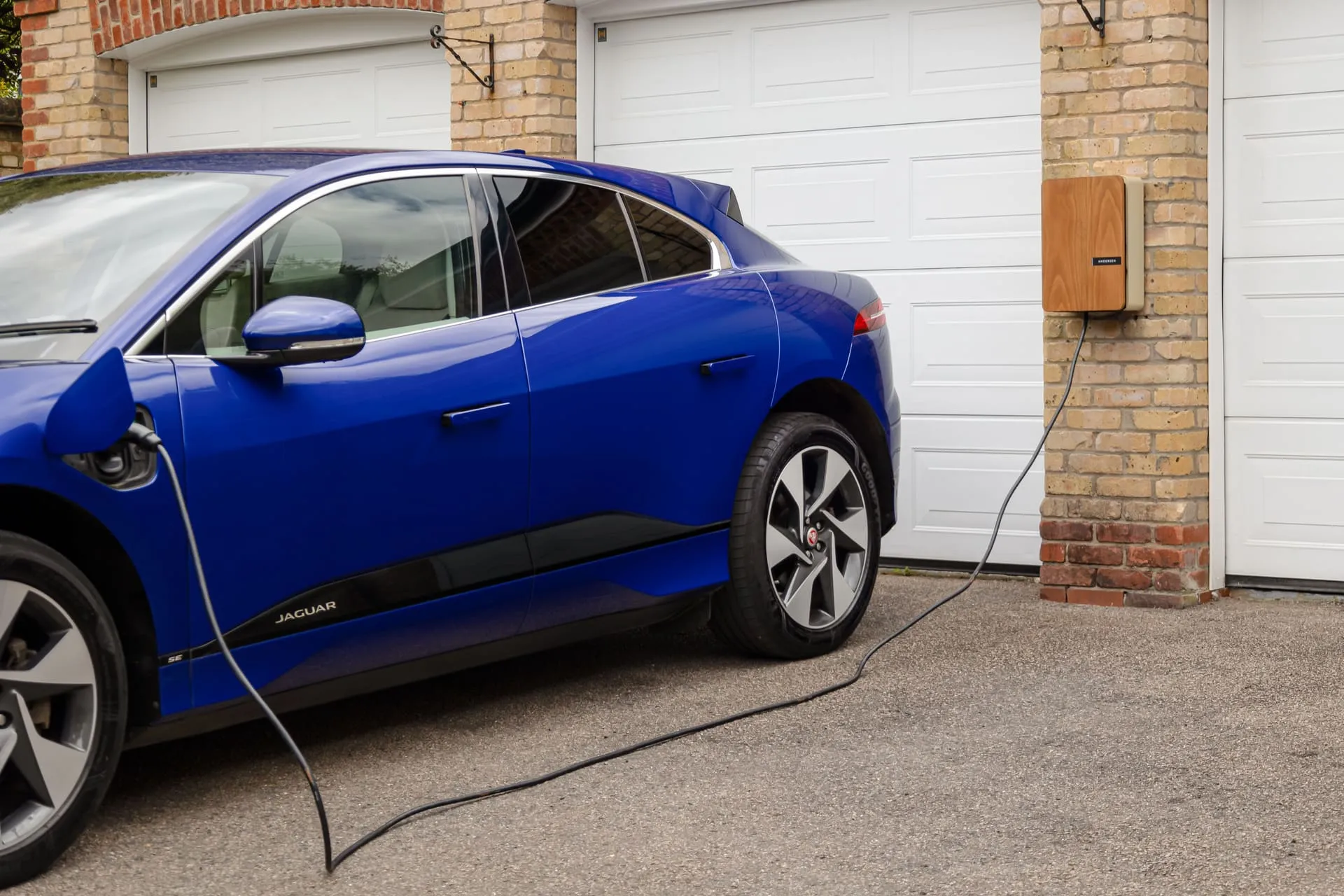
Stock photo, for illustration only. Last updated .
EV charger installation is quickly becoming one of the most requested electrical jobs in Adelaide. A dedicated home EV charger charges your car faster and more safely than a portable charger plugged into an ordinary power point, and a smart charger can make better use of rooftop solar and off-peak tariffs.
SuperFox is an enquiry service. We pass your enquiry to one local electrician, who calls you back, checks your switchboard and supply, and quotes. For other electrical work, see our electrician Adelaide hub.
What is a home EV charger?
A home EV charger, sometimes called a wallbox or wall connector, is a fixed charging unit mounted on a wall or post and wired to its own dedicated circuit. Compared with the portable charger many cars come with, it:
- charges much faster, often fully overnight even from low battery
- runs on its own protected circuit rather than sharing a power point
- can be smart, scheduling charging or following your solar output
- is built for daily use, with a tethered cable or a socket for your own cable
Do you need a dedicated charger?
Not always. If you drive short distances and park at home overnight, a portable charger on a good power point may be enough. A dedicated charger makes sense if you drive longer distances, have two EVs, want to charge from solar during the day, or find the portable charger too slow.
| Option | Typical use |
|---|---|
| Portable charger on a power point | Short daily trips, occasional top-ups |
| Single-phase wall charger | Most households, overnight charging |
| Three-phase wall charger | Faster charging where the home has three-phase supply and the car supports it |
Our guide to single-phase vs three-phase power explains the difference in plain terms.
SA Power Networks approval for EV chargers
In South Australia, SA Power Networks sets the rules for connecting larger chargers to the network. According to SA Power Networks:
- Portable chargers that plug into a standard power point, and dedicated chargers under 20 amps, don’t need an application.
- Chargers rated above 20 amps single-phase, or above 25 amps per phase on three-phase, need approval through the SA Power Networks portal before installation. Applications that meet the technical requirements are approved automatically.
- After installation, the approved application must be closed out.
- If the site’s supply capacity needs upgrading, a separate connection request is needed.
The electrician normally handles this paperwork for you. Ask them to confirm the application has been lodged and closed out.
What’s involved in EV charger installation
- Site check. The electrician looks at the switchboard, the main supply, existing load (air-con, hot water, solar, battery) and where the car parks.
- Choose the charger and location, close to where the charging port sits when parked, out of the way of car doors and foot traffic.
- Lodge the SA Power Networks application where the charger size requires it.
- Run a dedicated circuit from the switchboard, with suitable cable size and safety switch protection.
- Mount and connect the charger, then commission it, including any app or solar settings.
- Test, close out the approval and issue a certificate of compliance.
If the board is full or uses old fuses, the electrician may recommend a switchboard upgrade first.
EV chargers in Adelaide homes
South Australia has a high share of homes with rooftop solar, which makes smart EV charging attractive: charging in the middle of the day from surplus solar, or overnight on a cheaper tariff. Garages in older Adelaide homes are often detached or at the back of the block, which means longer cable runs. Carports and open driveways need a charger rated for outdoor use and positioned to stay out of the worst of the weather.
On hot summer afternoons, when air-conditioning load is high, a smart charger with load management can stop the house drawing more than the supply can handle.
What affects the price of EV charger installation?
We don’t publish prices; the electrician quotes after the site check. The main factors are:
- The charger itself: brand, power rating, tethered or socket, and smart features
- Distance from the switchboard to the charger
- Cable route: through walls, roof space, trenching or across a carport
- Switchboard condition and space for a new circuit and protection
- Single-phase or three-phase supply, and whether any supply upgrade is needed
- Load management if the home already has high demand
- Solar and battery integration
For more detail, see our guide to EV charger installation cost.
SA rules and what to ask the electrician
Installing an EV charger is electrical work, so it must be done by a licensed electrical worker. Licences are administered by Consumer and Business Services (CBS) and can be checked on the CBS public register. The electrician issues a certificate of compliance for the work. Check the charger’s manufacturer’s warranty terms, as they often require licensed installation.
Ask the electrician:
- Does my charger need SA Power Networks approval, and will you lodge and close out the application?
- Can my switchboard and supply handle the charger, or do I need upgrades?
- Will the charger have its own circuit and safety switch protection?
- Can it charge from surplus solar or on a schedule?
- Is the location suitable for outdoor use if it’s not under cover?
Getting your EV charger sorted
Send one enquiry through the contact form or call 08 6800 6079. Tell us your car, the charger you’re considering and where you park. We pass the details to one local electrician, who calls you back within 24–48 hours.